
A deficient rainfall season starts with heavy showers.

Coming down heavily on the Centre for rise in prices of essential commodities, Bihar Chief Minister Nitish Kumar on Thursday said Prime Minister Manmohan Singh's announcement to convene a meeting on the issue was like "starting digging a well to extinguish the fire".
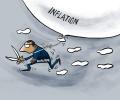
Wholesale price based inflation declined to a 3-month low of 1.89 per cent in November on cheaper food items, and experts predicted a 0.25 per cent interest rate cut by the RBI in the policy review in February. The Wholesale Price Index (WPI) based inflation was 2.36 per cent in October 2024. It was 0.39 per cent in November, last year. In August, 2024, it was 1.25 per cent.

The price rise in individual key food commodities over the last one year is significantly higher than what is conveyed by the wholesale price index. While the latest government data show inflation at 6.68 per cent for the week ended March 15, the price change in most food items is in double digits.

Investors lost Rs 24.69 lakh crore in market valuation in the last four days of severe drubbing in the equity market. Spike in global crude prices, unabated foreign fund outflows, a strong US jobs data diminishing early rate cut expectations, and the rupee logging its steepest single-day fall in nearly two years dampened investors' sentiment.

The margins of tyre manufacturers could come under pressure given the rise in rubber prices and the moderating demand for tyres. In the past three quarters, the revenue growth for listed tyre companies has moderated from low to mid-single-digit on account of factors such as lower demand in replacement segments, weak export markets and the decline in the average selling prices to car makers (OEMs). Demand trends could remain muted in the near term, given the weak passenger vehicle replacement demand, assuming a typical replacement cycle of 3-5 years, and demand moderation in the OEM segment.
India's exports are becoming less vulnerable to changes in world demand and exchange rates, according to a publication titled 'Re-examining Narratives: A Collection of Essays', penned by chief economic advisor (CEA) V Anantha Nageswaran and his team. The publication pointed out that this conclusion has been drawn from the fact that there has been a decrease in the income elasticity of exports to 3.44 during 2009-2022, from 5.67 during 1991-2008, and in the inverse price elasticity of exports to 0.4 from 2.7. While a decline in elasticities is favourable in the presence of downside risks such as a decline in global demand and an appreciation of exchange rates, it may not be beneficial during boom periods.
Opposition uproar over rising prices of essential commodities paralysed the proceedings in Parliament on Tuesday, with the Rajya Sabha adjourning for the day at noon and the Lok Sabha witnessing two adjournments.

Investors are reluctant to take long-term positions this year after the spectacular gains in 2023. The delivery-based trades on the National Stock Exchange (NSE) have declined to below 36 per cent this year from an average of 38.1 per cent in 2023. Investors tend to seek delivery for stocks where they see a long-term investment opportunity or tactical positional trade.

Gold, which lost its sheen to some extent in the second half of 2021, is likely to regain the glitter in the New Year and cross the Rs 55,000-per-10-grams level amid pandemic woes, inflation worries and stronger US dollar. After a stellar run up in 2020 when the yellow metal touched a record high of Rs 56,200 on the MCX in August, the prices are near Rs 48,000 per 10 grams now. This is roughly 14 per cent lower from the all-time highs and 4 per cent lesser compared to January 2021 levels.

Due to the continued pressure of high costs, Toyota is considering a price increase of up to 3 per cent across models with effect from January.

To check price rise, the government is importing some of the commodities to bridge the supply-demand gap and strengthening mechanism for providing subsidised items to poor, finance minister Pranab Mukherjee said on Wednesday.

Samajwadi Party chief Akhilesh Yadav on Monday criticized the Uttar Pradesh government over the severe traffic congestion in Prayagraj, claiming it has led to a shortage of essential commodities and inconvenienced devotees visiting the Maha Kumbh Mela. He also posted a video on X with people sharing their experiences and pointing out at the chaos. Yadav alleged that the officials are giving orders sitting in their rooms but are not coming down to the ground and that residents of Prayagraj have got nothing except filth, traffic jams and price rise.

The July-September quarter (Q2) results for 2024-25 (FY25) from the largest listed consumer electrical solutions companies, Havells India and Polycab India, followed similar trends, demonstrating robust revenue growth while falling short of profitability expectations. Both companies witnessed overall growth in the 16-30 per cent range, but margins declined by 130-290 basis points (bps) year-on-year (Y-o-Y). Although brokerages are bullish on long-term prospects and have raised revenue projections, earnings forecasts have been revised downward due to margin pressures.

However, the Polycab share price is up by nearly 80 per cent while Havells' has risen by 39 per cent. The Sensex has gained 26 per cent in this period. The Q1FY25 results were in line for both companies.

8 out of 10 households are planning to cut their tomato consumption if prices stay in the Rs 75-150 kg range over the next three months.

'The US is strongly placed to expand its crude supplies to India.'

'Investors looking at the next 6-12 months can be certain that the Fed will maintain its easing cycle, and we expect the overall environment to be conducive for fixed income investments for portfolio diversification.'

Fitch Ratings on Friday said it has revised the outlook on India's sovereign rating to 'stable' from 'negative' as downside risks to medium-term growth have diminished on rapid economic recovery. Fitch Ratings kept the rating unchanged at 'BBB-'.
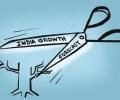
India's economy is projected to slow to 6.5 per cent in the fiscal year starting April but will remain the fastest growing major economy in the world as it fared better in dealing with the extraordinary set of challenges the globe has faced, the Economic Survey 2022-23 said on Tuesday. India's gross domestic product (GDP) growth of 6.5 per cent in 2023-24 compares with an estimated 7 per cent expansion in current fiscal year (April 2022 to March 2023) and 8.7 per cent in the previous year. Like the rest of the world, India too faced an extraordinary set of challenges in tightening financial conditions and supply chain disruptions from a prolonged war in Europe but "withstood them better than most economies", the annual document detailing the state of the economy said.

Irregular rainfall and a pick-up in commodity costs are expected to weigh on the demand and margins of fast-moving consumer goods (FMCG) companies. Most companies reported a sharp expansion in gross margins in the April-June quarter (first quarter, or Q1) of 2023-24 (FY24), given the lower prices of key raw materials and earlier price hikes. Furthermore, there were expectations that cost savings being passed on could reflect in volume growth going forward. However, these hopes could be dashed if demand recovery, especially in the rural segment, stalls, and gains on the raw material front start to recede.
Flaying the Congress-led United Progressive Alliance government at the centre, and holding it responsible for the unabated price rise, BSP leaders made it a point to stress that, "none other than Mayawati can bring down the prices in the country."

Top Left leaders Prakash Karat (Communist Party of India-Marxist), A B Bardhan (Communist Party of India), Debabrata Biswas (Forward Bloc) and Abani Roy (Revolutionary Socialist Party), led the demonstration near Parliament House.

Prices have continued to move up in Delhi's markets, wholesale and retail, on supply worries and spoilage due to record cold weather.
Days before the passage of the Finance Bill in the Parliament, Left party leaders on Friday met Prime Minister Manmohan Singh and demanded urgent steps by the United Progressive Alliance government to check growing prices of essential commodities. Top leaders of four Left parties, supporting the government placed six demands before him, saying these measures should be taken immediately to curb burgeoning prices.

'Through the course of the year, we expect the economic weakness generated by demonetisation will give way to normalisation of growth conditions.'

Global investors are fast losing appetite for equities, as deflation seems more of a reality. With commodity prices collapsing, few safe havens are left for investors, with many of the BRICS(Brazil, Russia, India, China and South Africa) losing their charm.

India recorded a current account surplus of $5.7 billion or 0.6 per cent of GDP in the March quarter, the Reserve Bank of India said on Monday. This is the first time in ten quarters that the crucial metric of the country's external strength has turned into surplus mode. In the year-ago period, the current account deficit stood at $1.3 billion or 0.2 per cent of GDP, and the same was $8.7 billion or 1 per cent of GDP in the preceding quarter ending December 2023.
Addressing the first annual conference of the chief secretaries, Singh reaffirmed Centre's commitment to assist States in everyway it can.

brass led by L K Advani on Wednesday submitted a memorandum on rising prices of sugar and essential commodities to Prime Minister Manmohan Singh who assured that the government would take appropriate steps to keep a check on it. Besides Advani, party president Nitin Gadkari, senior BJP leaders Sushma Swaraj, Arun Jaitley, Rajnath Singh, S S Ahluwalia, Ananth Kumar were also part of the delegation.
The opposition's uproar over rising prices of essential commodities paralysed the proceedings in Parliament on Tuesday, with the Rajya Sabha adjourning for the day at noon and the Lok Sabha witnessing two adjournments.

Tata Motors, Ford, Nissan, Maruti Suzuki, Toyota Kirloskar, BMW, Renault and Isuzu have also announced price hike from next month citing impact of increase in commodity prices and foreign exchange rates.
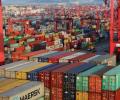
After the first quarter was washed out, exporters are now keeping their fingers crossed over a turnaround in outbound shipments to at least North America from September onwards. This comes even as other key destinations such as Europe may take longer to revive in FY24. Slowdown in key economies, as well as geopolitical tensions resulted in sluggish demand for Indian goods.

Passenger vehicle wholesales in India rose significantly year-on-year in July, as COVID-led restrictions eased across states and companies pushed stocks to dealers to build up inventories for the upcoming festive season, SIAM said on Thursday. The total passenger vehicle sales -- including dispatches of cars, utility vehicles and vans -- from OEMs to dealerships increased by 45 per cent to 264,442 units in July against 182,779 units in the same month last year. According to the latest data by the Society of Indian Automobile Manufacturers (SIAM), two-wheeler dispatches from the OEMs to dealerships, however, declined by 2 per cent to 12,53,937 units in July, compared to 12,81,354 units in the year-ago period.

International Monetary Fund Chief Economist Gita Gopinath tells Indivjal Dhasmana high-frequency indicators for the third quarter of 2021 indicate momentum in economic recovery in India.

The RBI on Wednesday cautioned that while the Indian economy appears capable of weathering the deterioration in geopolitical conditions amid the ongoing Russia-Ukraine war, it faces headwinds from global spillovers from geopolitical tensions, elevated commodity prices and moderating external demand. The RBI, however, did not tinker with the GDP growth projection made in April. It had slashed the GDP growth projection for the fiscal 2022-23 to 7.2 per cent from its earlier forecast of 7.8 per cent.

Leader of Opposition Mallikarjun Kharge, speaking on the Motion of Thanks on the President's address, charged the government with not delivering on its various promises, including generating two crore jobs per year.

Retail inflation inched up to 4.48 per cent in October due to an uptick in food prices, government data showed on Friday. The Consumer Price Index (CPI) based inflation was at 4.35 per cent in September and 7.61 per cent in October 2020.
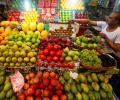
The Reserve Bank on Wednesday projected retail inflation to ease to 5.3 per cent in next fiscal from 6.5 per cent this year on assumptions of lower imported inflation, even though core inflation remains sticky. The RBI's inflation outlook for current fiscal has improved from 6.8 per cent projected earlier, to 6.5 per cent, on the back of steeper than expected decline in vegetable prices and Indian basket of crude at $95 a barrel. "Looking ahead, while inflation is expected to moderate in 2023-24, it is likely to rule above the 4 per cent target.
